Where architxt fits
architxt is a self-hosted, open-source application layer that turns solid architecture documentation, wikis, diagrams, and existing EA exports into a queryable, evidence-linked model. It then bridges that model into EA tools, knowledge stores, RAG systems, and human decision workflows — without replacing them.
It is not an enterprise-architecture repository, a code-analysis tool, or a blank knowledge-graph canvas. It sits between the messy human-readable artifacts your organisation already produces and the systems that need a cleaner, queryable architecture layer.
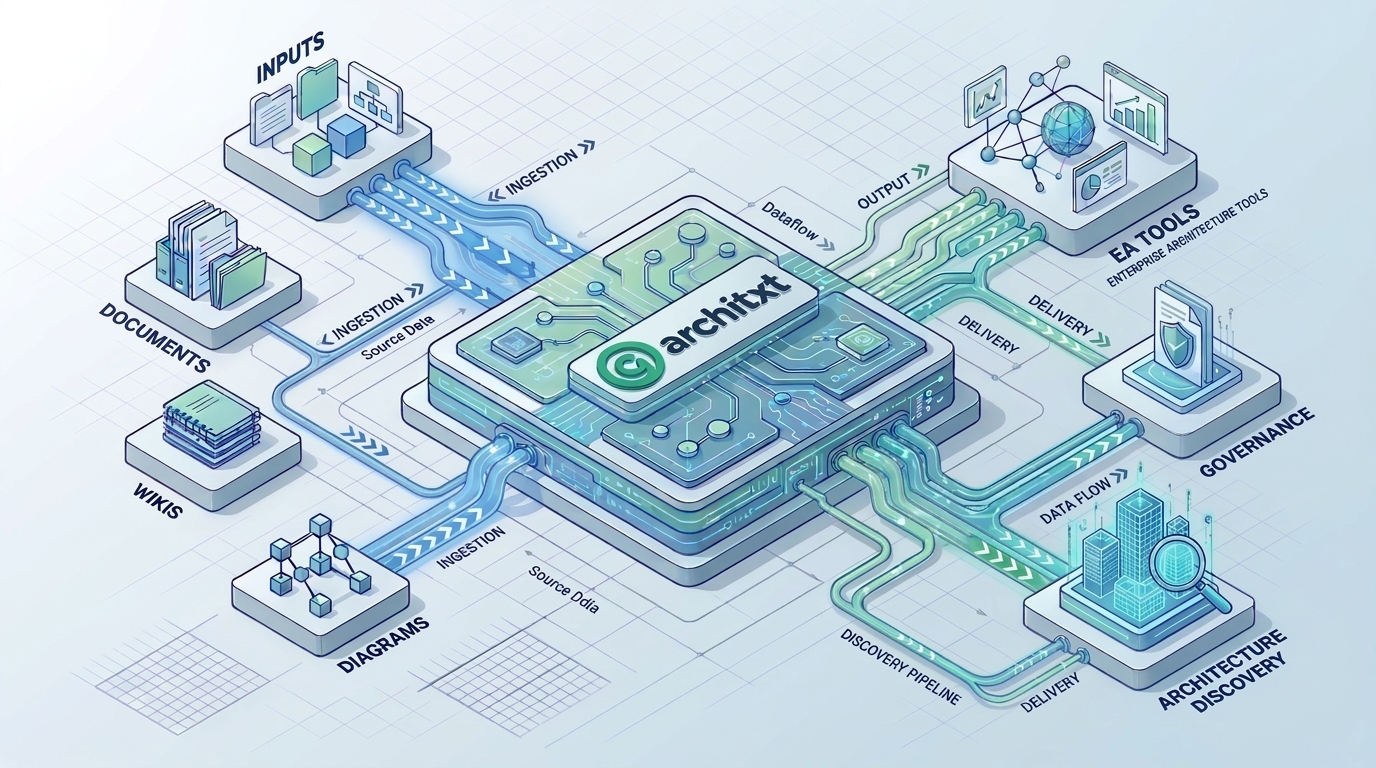
What feeds architxt
- Documents — Word, PDF, Markdown solution designs, tech specs, runbooks
- Document images and diagrams — extracted and converted to systems inventory and relationships
- Wikis — Confluence, Notion, SharePoint, GitHub wikis
- Diagrams-as-text — Mermaid, PlantUML, draw.io source files
- Existing EA exports — Archi/ArchiMate, LeanIX, Ardoq CSV/GraphML
- Human-readable repo artifacts — READMEs, service descriptions, API specs
Where the model goes
| Consumer | Value from architxt |
|---|---|
| EA and modelling tools (LeanIX, Ardoq, Archi/ArchiMate, TOGAF repos) | Evidence-linked current-state model to enrich formal repositories |
| Knowledge stores and RAG layers | Structured, grounded architecture facts instead of raw document chunks |
| Internal AI agents | Queryable graph and AQL as a reasoning surface |
| Visualisation and reporting tools | Graph exports: JSON, GraphML, GEXF, Cypher, CSV |
| Governance and review processes | Queryable as-is model plus impact and dependency answers |
| CMDB, ITAM, ITSM | Entity mappings and dependency data |
| Onboarding and training systems | Structured architecture map that survives expert turnover |
| Compliance and audit tooling | Traceable links between documents, decisions, and entities |
Use cases
Fundamental applications for architxt are captured in these use cases.
1. Discover current-state architecture and recurring patterns
The organisation already has architecture documentation but lacks a coherent, queryable view of the as-is structure and repeated design patterns.
architxt takes existing documentation sources and builds a contextual graph which contains carefully curated facts and relationships which can be queried at multiple levels — rather than just searching for named items.
Linked benefits: Discover current-state architecture, Detect gaps, seams, and architecture erosion, Query for specifics with accuracy and quality, and Stop design-document shelfware.
2. Architecture recovery after M&A or team turnover
A merger, acquisition, or departure of key architects leaves the organisation holding unfamiliar systems with scattered documentation.
architxt ingests docs, diagrams, wikis, and existing EA exports as they are — with a pipeline for advanced clean up and entity embedding — and reconstructs a queryable as-is architecture from degraded, real-world artifacts.
Linked benefits: Discover current-state architecture, Save time finding architecture information, Faster architect onboarding, and Barrier 1: existing data location, format, and quality.
3. Pre-change impact and dependency analysis
A team is planning a migration, deprecation, re-platforming, or large-scale change and needs to understand blast radius before committing.
architxt uses the extracted contextual graph and AQL/Reflect queries to answer precise, grounded questions — "what depends on X?", "what was the rationale for this decision?" — and surfaces seams, gaps, and undocumented dependencies before work begins.
Linked benefits: Query for specifics with accuracy and quality, Detect gaps, seams, and architecture erosion, Stop design-document shelfware, and Barrier 2: domain expertise and pipeline-design effort.
4. Sovereign architecture knowledge base for regulated environments
A regulated, government, or data-residency-sensitive organisation cannot send proprietary architecture content to external, cloud-hosted LLMs.
architxt provides a fully self-hosted, open-source ingestion and querying layer over architecture documents, keeping proprietary knowledge inside the organisation’s own infrastructure.
Linked benefits: Data sovereignty, on-premise, and open-source, Stop design-document shelfware, and Barrier 1: existing data location, format, and quality.